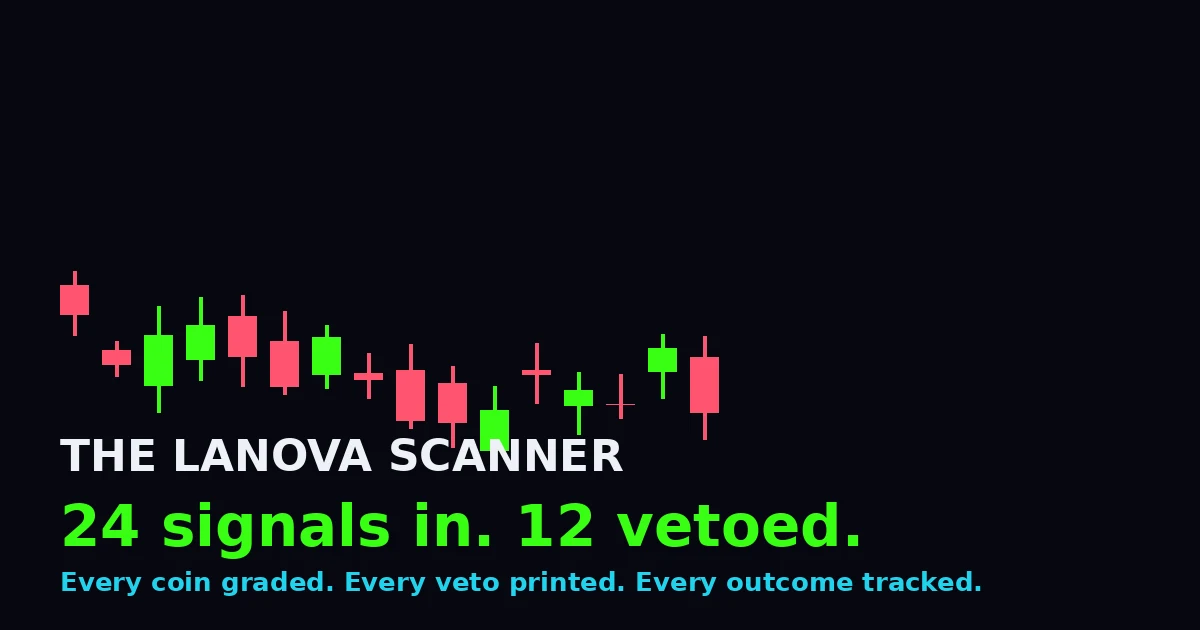
24 Signals In, 12 Vetoed: Everything About the Lanova Scanner
Listen to this post
Last night our scanner looked at 24 coins and refused to pick half of them. Twelve signals came in, got graded, and then got vetoed by our own safety gates — printed in the feed with the reason attached, not quietly deleted. That ratio surprises people. It shouldn't. Most new coins are dangerous, and a scanner that picks almost everything it sees isn't scanning. It's applauding.
I'm Paul, I built this thing, and this is the full tour: what the scanner does every 15 minutes, how the grade works, what the vetoes are, the new Move Check layer, the chart desk that just grew candlesticks and a top 100 — and the part I care about most, which is what our own outcome numbers say about all of it. Some of those numbers make us look good. One of them doesn't. It's all in here.
Key takeaways
• The scanner runs every 15 minutes and publishes each coin with 55 data fields, a Lanova Grade, and a safety-gate result.
• On the latest feed: 24 signals, 12 vetoed by eight hard veto rules — mint authority still active, top-10 wallets over 70%, liquidity under $25,000, and five more.
• We register every coin before the gates run. The tracker now holds 5,998 coins, so nobody here can cherry-pick a track record.
• In our first 24-hour report, the median tracked coin fell 43.5% in a day — and higher scores did worse, not better. We published that anyway.
• The chart desk now draws real candlestick charts for scanner coins and the top 100, with a plain-English explainer for every tool on the page.
The Scanner Shortlist — free, every morning. Our scanner and safety notes, in your inbox before the market wakes up.
Join freeIn this post
· What the scanner does every 15 minutes
· The vetoes: why half the feed got thrown out
· Move Check: why we compare a coin to itself
· The chart desk: candlesticks, the top 100, and honest labels
· The part most scanners skip: we track what happens next
What the scanner does every 15 minutes
The scanner watches newly trading Solana coins and works in a loop. Every 15 minutes it pulls the newest candidates, checks each one against live market and on-chain data, grades it, runs it through the safety gate, and publishes the result to the RawScan feed. Nothing waits for a human. Nobody here wakes up and decides which coins look good today — the machine publishes what it finds, good or bad, and I read the same feed you do.
Each published coin carries 55 fields: price, liquidity, volume, buy pressure, holder concentration, mint and freeze authority status, liquidity-lock depth, a risk reading, and the indicator set — RSI, EMA trend, MACD, Donchian and Bollinger readings, the classic chart tools, each defined in plain words where it appears. Fifty-five fields is more than anyone reads over coffee. That's fine. The point is that the grade below is built from shown work, not from a black box asking for trust.
How the Lanova Grade works
The grade comes in three steps, and the order matters. First, a scanner score from 0 to 100 rates how the coin trades: liquidity depth, volume turnover, buy pressure, momentum, age, and hourly activity. Parabolic and collapsing coins score low on momentum on purpose — a coin up 300% in an hour is not "strong" to us, it's late.
Second, when we have holder data, a safety supplement adjusts the score using holder distribution and a safety margin — whether mint and freeze authority are renounced, how much liquidity is locked, and a risk reading. If a cycle returns no holder data, we don't invent the supplement. The grade falls back to the plain score and the published reason says so. That fallback exists because missing data crashed our grader once, on November 25. We fixed the crash by admitting the gap instead of filling it in.
Third, an indicator-alignment count — how many of the five chart readings agree — turns the result into the letter, A to F. The full formula, with every threshold, lives on our methodology page. Read it and you can rebuild our grade yourself. That's deliberate.
The vetoes: why half the feed got thrown out
Before any ranking, every coin faces eight hard vetoes. Any one of them removes the coin from our picks. It stays in the feed, labelled vetoed, with the reason printed. Here they are, exactly as the code enforces them:
| Veto | Rule |
|---|---|
| Reported rugged | Our risk source reports the token as rugged. |
| Mint authority active | Supply can still be inflated. Only positively known data fires this — unknown never vetoes. |
| Freeze authority active | Wallets can still be frozen by the creator. |
| Top-10 concentration | The top 10 holders control more than 70% of supply. |
| Top-1 concentration | The largest holder, excluding pool and bonding-curve accounts, holds more than 30%. |
| Liquidity unlocked | Less than 50% of the liquidity pool is locked, and the pool is not burned. |
| Token-2022 traps | A permanent delegate is set, a transfer hook is set, or accounts are frozen by default. |
| Liquidity floor | Liquidity below $25,000. |
Last night, 12 of 24 signals tripped at least one of these. One coin tripped three at once — mint and freeze authority still active, liquidity unlocked, and a Token-2022 permanent delegate sitting in its contract. On paper its chart looked lively. The gates don't care how lively a chart looks.
One more thing, because people get this wrong: a veto is not a prophecy. It doesn't say a coin must fail. It says one named, checkable risk is present right now. And a grade is not a pass — we've published a token graded A that was still vetoed because none of its liquidity was locked. Read the gate first, the grade second. Our separate safety reports work the same way: 13 checks listed as PASS, FLAG or NOT CHECKED, never averaged into one comforting "safety score," because an average is exactly where a fatal flaw goes to hide.
Move Check: why we compare a coin to itself
The newest layer is called Move Check, and it answers a different question: not "is this coin good?" but "is this coin behaving strangely right now?" It tracks six factors — price move, volatility, volume, buy-pressure shift, liquidity change, and score momentum — and scores each one as a z-score, which is a standard way of asking how unusual a reading is compared to that coin's own recent history. A coin that always swings wildly gets judged against its own wild baseline. A quiet coin that suddenly doubles its volume stands out, because for that coin, that's strange.
When a coin is too new to have 12 of its own readings, Move Check says so and falls back to comparing it against coins first seen around the same time — the page labels that honestly as cohort mode. Any factor that reaches a z-score of 2.0 or beyond gets flagged, and every flag comes with a plain-English sentence built from the real numbers, never a template with the blanks filled by vibes. If a number is missing, the factor is simply left out. The full method, with a worked example pulled from live data, is on the Move Check Learn page.
The chart desk: candlesticks, the top 100, and honest labels
A grade without a chart is a claim. So the scanner now has a chart desk at lanovacrypto.com/chart, and last night it grew up. Every scanner coin gets a page with real candlestick charts — the green and red candles that show open, high, low and close for each period — built by bucketing our own tracked price readings into candles. Alongside them sit pages for the top 100 coins by market size, Bitcoin, Ethereum, Solana and the rest, drawn from CoinGecko's candle data at 180 candles per coin. Same desk, same tools, whether the coin launched an hour ago or a decade ago.
On every chart page you can toggle the overlays — EMA, the average that smooths price over time; Bollinger Bands, which stretch with volatility; Donchian channels, which mark the recent high and low — and open the RSI and MACD panels below. Each page carries a "What each tool does" section: what the tool shows, what traders read from it, and the catch. Because there is always a catch, and a tool page that won't tell you the catch is selling you something. Coins with too little data don't fake a candle chart — they fall back to a line with a note saying exactly why. You can test all of it, and stress it against your own questions, in the Data Lab.
The part most scanners skip: we track what happens next
Here's the design choice I'm proudest of, and it's unglamorous: the scanner registers every coin into our outcome tracker before the gates run. Vetoed coins count. Embarrassing coins count. As of last night the tracker holds 5,998 coins by contract, each followed from first sight. That means our track record is whatever reality says it is — we built the system so we couldn't cheat it even if we wanted to.
And reality, so far, is blunt. We published our first 24-hour outcome report this week, covering the 1,395 coins with a complete first day of tracking:
| First 24 hours, 1,395 tracked coins | Result |
|---|---|
| Median coin after 24 hours | −43.5% |
| Coins that lost half their value or more | 47.9% |
| Coins that finished the day up | 18.1% |
| Higher scanner scores in that window | Did worse, not better |
Read that last row again. In that first cohort, our higher-scored coins performed worse over 24 hours than the lower-scored ones. A lot of teams would bury that table. We put it in a report with our name on it, because a scanner whose publisher hides its own base rates is asking for a kind of trust it hasn't earned. The grade measures structure and risk we can check. It does not measure tomorrow, and the tracker exists to keep proving that to us, in public, whether we like the answer or not.
The same standard runs our bot arena
The scanner doesn't grade on a curve, and neither do we. Over at the bot arena, every paper-trading strategy faces the same published bar: at least a 60% win rate, at least 30 trades, and at least 10% net profit after costs. Two of our entrants failed that bar. They are still on the public scorecard, marked FAIL, because a scorecard that only shows winners is marketing, not a record. Scanner, bots, tracker — one rule runs through all of it: publish the method, publish the misses, let the numbers argue.
What it costs
The scanner, the safety gates, the outcome data and the whole chart desk are free to use. That's the front door and it stays open. If you want the full Lanova set — every app's Pro features in one bundle — that's All-Access at $10.99 a month, payment first, no free trial, with a 30-day money-back guarantee. And one boundary we never cross, in this post or anywhere on the site: nothing here is financial advice. The scanner shows its work. What you do with the work is yours.
Questions people actually ask us
What does the Lanova scanner do?
Every 15 minutes it scans newly trading Solana coins and publishes each one with 55 data fields, a Lanova Grade, and the result of a hard safety gate. Coins that fail the gate stay in the feed, labelled vetoed, with the reason printed. Every coin is registered before the gates run, so its later outcome counts in our track record either way.
Why did the scanner veto half its own feed?
On the latest feed we checked, 12 of 24 signals tripped at least one of eight hard vetoes: things like mint or freeze authority still active, the top 10 wallets holding over 70% of supply, less than half the liquidity pool locked, or liquidity under $25,000. A veto is not a judgment that a coin must fail. It means one specific, named risk is present, and we would rather print the risk than hide it.
Does a high scanner grade mean a coin will go up?
No, and our own data says so out loud. In our first 24-hour outcome report, 1,395 tracked coins had a median result of minus 43.5% after one day, and the higher-scored coins actually did worse than the lower-scored ones in that window. The grade describes how a coin trades and what risks we can measure. It is not a prediction, and nothing on Lanova is financial advice.
Is the Lanova scanner free to use?
Yes. The scanner feed, the safety gates, and the chart desk — candlestick charts for scanner coins and the top 100 — are free to use. All-Access at $10.99 a month bundles the full Lanova set of apps and Pro features, is payment-first with no free trial, and carries a 30-day money-back guarantee.
Paul Geller — founder of Lanova, built in public from Ocean Springs, Mississippi.
I write these the way I'd want them read to me: numbers first, misses included.
How we work — the trust block. Lanova is built and run by Paul Geller, founder of Nova Bliss, Ocean Springs, MS. Data provenance: Lanova scanner feed (RawScan), Lanova outcome tracker, CoinGecko candle data for top-100 charts, all as of the dates printed on this page. We charge a 0.25% fee on trades made through our own swap paths, and paid plans are payment-first with a 30-day money-back guarantee. This page is research and education, not financial advice — crypto is risky, new coins are riskiest, and you can lose everything you put in. Corrections: if a figure here is wrong, we fix the page and note the fix; write to us through the About page.
The Scanner Shortlist — free, every morning. Our scanner and safety notes, in your inbox before the market wakes up.
Join freeLanova · Research only — not financial advice · Scanner data as of November 26, 2026, 11:30 p.m. Central · Published November 27, 2026